From a resting place to a pilgrimage complex
At the centre of Ajmer Sharif is the resting place of Hazrat Khwaja Moinuddin Hasan Chishti (RA), beloved as Gharib Nawaz. Around it, gateways, courtyards, mosques and spaces serving pilgrims form a much larger sacred precinct. The Dargah developed through successive periods of patronage, building and care; no single construction date adequately describes everything a visitor sees today.
Its heritage has two connected dimensions: the physical record of buildings and craftsmanship, and the continuing life of prayer, pilgrimage, gathering and hospitality. Reading the architecture without noticing its present use gives only part of the picture. The people moving through these spaces have come to a place of worship as well as a historic landmark.
For the saint’s background and spiritual lineage, begin with the full account of his life. This page follows the development and character of the place where he is remembered.
Mughal pilgrimage and patronage
Historian Pratyay Nath documents seventeen pilgrimages by Emperor Akbar to Ajmer between 1562 and 1579. These journeys combined devotion with the public presence and practical work of kingship. They helped make Ajmer important within the political geography of the Mughal Empire as well as its religious life. Source: Pratyay Nath · Akbar’s pilgrimages to Ajmer (2022)
Rajasthan Tourism identifies mosques in the precinct associated with Akbar and Shah Jahan. Imperial patronage contributed to the built setting, but the shrine’s story also belongs to ordinary pilgrims, caretakers, craftspeople and benefactors whose continuing involvement sustained it. Source: Rajasthan Tourism · Ajmer Sharif Dargah
A building’s name, its original construction and later alterations are separate questions. Understanding these layers is more useful than treating every visible feature as the work of one emperor.
The three named gateways
Rajasthan Tourism identifies the Nizam Gate with the Nizam of Hyderabad, the Shah Jahani Gate with Shah Jahan, and the Buland Darwaza with Sultan Mahmud Khilji. Together, these names make different periods of patronage visible in one sacred setting. Source: Rajasthan Tourism · Ajmer
Look at the gateways as transitions between spaces: their scale, ornament and relationship to the courtyards help shape the approach to the shrine. The Buland Darwaza here should not be confused with a monument of the same name elsewhere in India.
This is an architectural introduction, rather than a promise about the entrance you will use. Routes through the precinct can change with ceremonies, crowds and local arrangements; follow the directions given on the day.
The central tomb and its courtyards
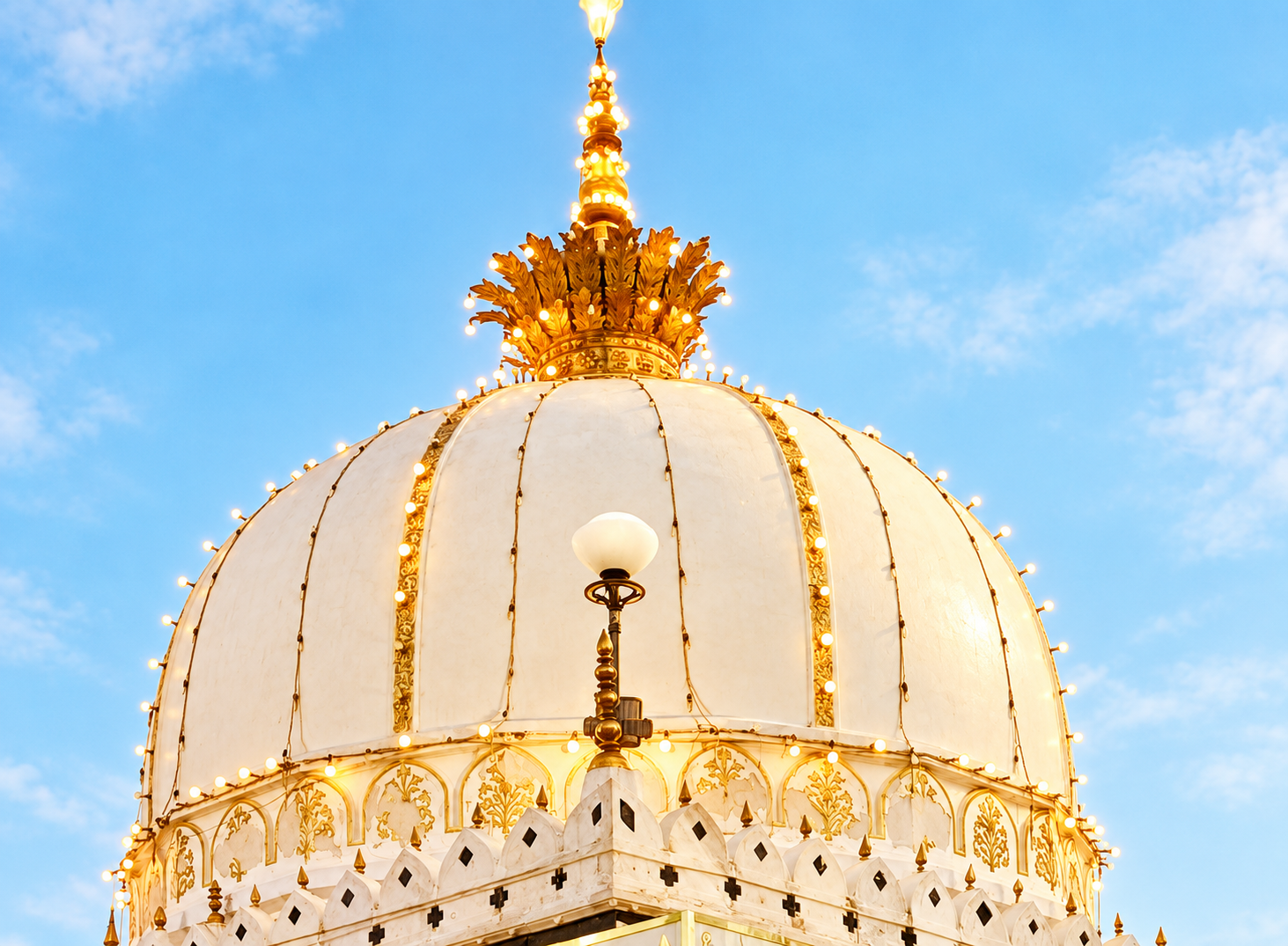
The central tomb stands within a domed Astana, with a marble screen and silver railing described in the government’s cultural introduction. The surrounding courts frame the approach to this devotional centre. Source: India Cine Hub · Dargah Khwaza Sahib, Ajmer
Give yourself time to notice materials and details: stone surfaces, metalwork, inscriptions and the changing light. A close photograph of the dome cannot convey the whole relationship between the tomb, the courtyards and the people using them.
Photographs can also make spaces look larger, quieter or more accessible than they are during a visit. Ask about photography and access before approaching an interior. Keep passages clear and allow worshippers to move without having to step around a camera or a group.
Mosques, halls and service spaces
Incredible India lists the Akbari Masjid, Mehfil Khana, Langar Khana, Sandal Khana Masjid and the tomb of the saint’s daughter among the complex’s features. It also identifies the white-marble Jami Masjid built by Shah Jahan. Source: Incredible India · Dargah and Beyond
These names help reveal the range of activities accommodated within the precinct: congregational prayer, gathering, remembrance and the service of food. Distinguishing these places is more informative than referring to every structure as “the Dargah building.”
When a building’s identity is unclear, ask someone responsible at the site before attaching a name to your photographs. A mosque remains a place of prayer, and a historic interior is not necessarily open for sightseeing at every hour.
The degs and the sharing of food
The great cooking vessels are among the Dargah’s familiar landmarks. A deg is the vessel; langar refers to the shared meal and its distribution. Rajasthan Tourism describes vegetarian food being prepared in the shrine’s large vessels and shared with devotees. Source: Rajasthan Tourism · Ajmer
The meaning of this service extends beyond the spectacle of an enormous cauldron. Preparation, cleanliness, fair distribution and care for the people receiving food are equally important. If you wish to contribute, establish who will organise the cooking, what will be provided and how it will be distributed. Our offerings guide explains these practical questions.
Encountering and preserving living heritage
A useful way to explore Ajmer Sharif is to begin with the saint’s life, then identify the principal buildings, and finally consider the traditions that connect them. This gives individual details a context: a gateway is an approach, a courtyard a shared space, and a service kitchen a place where an offering becomes food for others.
When sharing your visit, distinguish an observation from a story you heard. Name a building or ceremony only when you know what it is; leave an uncertain photograph undated rather than assigning it to a particular Urs. Our gallery identifies image sources and visual treatments, because a digitally enhanced scene is not historical evidence.
Continue with the Urs guide for the annual remembrance, or the visitor guide for practical preparation. Together, these accounts connect the history of the place with a considered visit today.