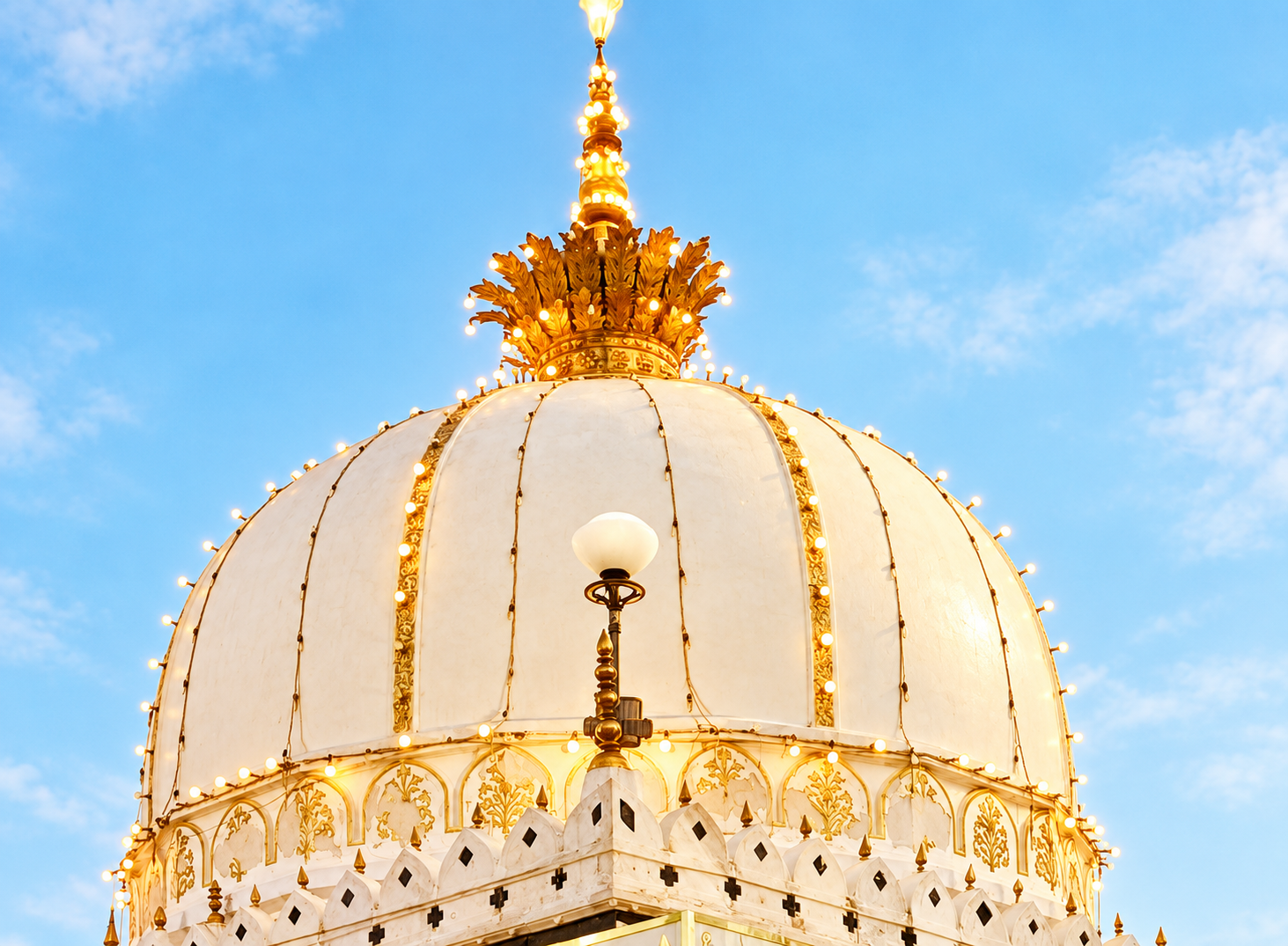
The saint remembered as Gharib Nawaz
Hazrat Khwaja Moinuddin Hasan Chishti (RA) occupies a cherished place in the spiritual life of South Asia. His resting place in Ajmer, Rajasthan, draws people who arrive with prayers, gratitude, grief and hope. The name Gharib Nawaz expresses the quality for which devotees especially remember him: care for those in need. Khwaja Sahib, Khwaja Ajmeri and Moinuddin Chishti are familiar names for the same revered saint.
His story joins several histories: a seeker’s journey from the Persian-speaking world, the growth of the Chishti spiritual tradition in India, and the development of Ajmer into a place of enduring pilgrimage. Understanding these together gives his life more depth than a list of dates or celebrated anecdotes alone.
A life and legacy in sequence
This chronology separates the remembered stages of the saint’s life from the later growth of his shrine. Approximate periods are kept approximate. Dates of rulers’ visits belong to the history of the Dargah, not to personal meetings with Khwaja Sahib.
| Period | Life or legacy |
|---|---|
| Twelfth century | Birth commemorated on 14 Rajab; early life in the Sistan–Khurasan region. |
| Years of learning and travel | Bukhara, Samarkand and the guidance of Usman Haruni; the remembered pilgrimages belong to this formative period. |
| Late twelfth / early thirteenth century | Settlement in Ajmer. Sources differ about the exact arrival year. |
| 1236 · 6 Rajab in devotional remembrance | Wisaal in Ajmer; the annual Urs follows the lunar calendar. |
| Later medieval centuries | The shrine develops and pilgrimage expands beyond the saint’s own lifetime. |
| 1562–1579 | Akbar’s repeated pilgrimages connect devotion with the wider history of the Mughal Empire. |
Origins, childhood and a turning point
The early-life tradition places his birth in Sistan in the twelfth century. Historical biographies give different birth years; the often-repeated precise dates should therefore be read as traditional chronology. Sistan and Khurasan belonged to a wider cultural world of scholarship, trade and spiritual travel whose geography does not fit neatly into today’s national borders.
An account preserved in the historical literature tells of a young man who inherited a garden and mill after his father’s death. Meeting the dervish Ibrahim Qandozi became a turning point: he relinquished his possessions and set out in search of knowledge. This is a devotional account of awakening, rather than a surviving eyewitness report. Its significance lies in the change it describes—from attachment to property towards generosity, learning and spiritual purpose.
H. B. Sarda, Ajmer: Historical and Descriptive (1911), ch. VIII, pp. 87–90; IGNCA scan
Learning and the guidance of Usman Haruni
Biographical tradition connects his search for learning with Bukhara and Samarkand, and his spiritual formation with Khwaja Usman Haruni near Nishapur. Usman Haruni is remembered as his pir, the guide through whom he entered the Chishti path. Accounts describe years of travel and companionship; their exact duration cannot be reconstructed securely.
The relationship helps explain a central Sufi idea: spiritual education develops through disciplined practice and the company of a teacher, alongside learning. A silsila is a chain of spiritual transmission. It records a relationship of guidance and responsibility, and should not be confused with a biological family tree.
Why the tradition is called Chishti
The name comes from Chisht, a settlement near Herat in present-day Afghanistan. The tradition therefore existed before Khwaja Sahib’s life in Ajmer. His importance lies in its establishment and lasting influence in the Indian subcontinent. Chisht and Ajmer represent different stages of that history, not two names for the same place.
To read the saint’s journey in this wider setting is to see a tradition carried through people: teachers, disciples and communities who learned, travelled and formed new centres of devotion. Ajmer became a particularly enduring home for that inheritance.
Pilgrimage and the wider journey
H. B. Sarda’s Ajmer: Historical and Descriptive preserves a detailed traditional itinerary. After the period with Usman Haruni, it places Khwaja Sahib in Mecca and Medina, then Baghdad, and later in cities including Isfahan, Herat, Sabzwar, Balkh and Ghazni. These names show the geographical breadth of the remembered journey: the holy cities of Islam, centres of scholarship and the routes leading towards South Asia.
In this account, pilgrimage and learning form parts of one vocation. Mecca and Medina link the seeker’s life to the sacred centres of Islam; companionship with teachers and encounters along the route connect that devotion with a wider spiritual community. The journey ends in settlement rather than perpetual wandering, with Ajmer becoming the place most closely identified with his service.
Sarda wrote centuries later and collected earlier traditions; his itinerary is valuable evidence of how the life was remembered. It is not a travel diary. Modern scholarship does not substantiate every reported meeting with famous contemporaries, and the exact route and sequence remain uncertain. These travels are therefore presented as attributed biographical tradition.
H. B. Sarda, Ajmer: Historical and Descriptive (1911), ch. VIII, pp. 87–90; IGNCA scan
The journey to Ajmer and life in the city
His travels eventually brought him to Ajmer, where his life and remembrance became rooted. Sources place the arrival around the transition from the twelfth to the thirteenth century, but disagree about its exact year. Accounts of journeys through Lahore and Delhi belong to the biographical tradition; a precise modern itinerary would imply more certainty than the evidence allows.
Ajmer was already an important city. His later fame did not arise in an empty landscape: it developed within a place with established political, commercial and religious life. In time, the saint and the city became closely connected in the imagination of devotees. The name “Ajmeri” still carries that association.
Devotion expressed through character and service
In the living Chishti tradition, devotion to Allah, compassion and care for others belong together. Inner refinement is expressed in conduct: humility rather than pride, generosity rather than indifference, and a willingness to help people who arrive in difficulty. Khwaja Sahib’s remembrance continues to give these values a human focus.
These themes are a summary of the tradition, not a set of verbatim sayings attributed to him. For a reader today, they offer a practical question: how can remembrance become useful kindness? Feeding someone, making space for a stranger and treating a vulnerable person with dignity are ways to reflect on that question without claiming a guaranteed spiritual reward or material outcome.
Disciples and the generations that followed
Khwaja Qutbuddin Bakhtiar Kaki (RA), remembered at Mehrauli in Delhi, was a disciple of Khwaja Moinuddin Chishti (RA). This connection carried the spiritual inheritance beyond Ajmer. Later generations include Baba Farid and Hazrat Nizamuddin Auliya; they should not all be described as Khwaja Sahib’s direct pupils.
NCERT places these teachers within a long Chishti succession. Teaching circles, hospices and the remembrance of earlier guides helped sustain the tradition across regions. The enduring influence of Khwaja Sahib is therefore visible both at his shrine and in the wider network of Chishti learning and devotion.
National Mission on Monuments and Antiquities: Bakhtiar Kaki
Family, remembered lives and historical evidence
Sarda’s account names two wives, Amatullah and Asmat Bano, and records three sons—Khwaja Fakhruddin, Khwaja Abu Said and Khwaja Hisamuddin—and a daughter, Bibi Hafiz Jamal. These names are given as the family tradition preserved in that historical work; spellings vary in transliteration. The text associates Fakhruddin with Sarwar and remembers Bibi Hafiz Jamal for her piety, locating her tomb within the shrine setting.
Family remembrance adds a domestic dimension to the life of a figure often encountered only through titles and pilgrimage. It also connects the saint’s history with places beyond the central mausoleum. Sarda’s early twentieth-century account should not, however, be used as a current access guide to individual tombs.
For later families, biological descent, spiritual succession and hereditary service remain distinct relationships. Recording the saint’s children does not establish an unbroken genealogy to a person living today; that requires its own documentary evidence.
H. B. Sarda, Ajmer: Historical and Descriptive (1911), ch. VIII, pp. 87–90; IGNCA scan
Wisaal in 1236 and the meaning of Urs
Khwaja Sahib passed away in Ajmer in 1236. The devotional calendar commemorates his wisaal on 6 Rajab. Urs expresses the Sufi understanding of death as reunion with the Beloved; the annual remembrance combines prayer, homage and the gathering of devotees.
The commemoration follows the Islamic lunar calendar, so its Gregorian dates move each year. A historical anniversary is not a current programme: travel dates and arrangements need the announced calendar for the relevant year. Read the Urs guide for the meaning of the observance and preparation.
How a life became an enduring place of pilgrimage
The present shrine developed over generations after the saint’s death. Mughal patronage enlarged its public importance. Historian Pratyay Nath’s study traces Akbar’s repeated journeys between 1562 and 1579, showing that devotion, kingship and the development of empire were intertwined. Akbar lived centuries after Khwaja Sahib; he visited the shrine, not the saint in person.
Today, the marble, courtyards and gates belong to this accumulated history. They frame a living place of remembrance rather than the unchanged setting of the saint’s own lifetime. Continue with the history of the Dargah to follow the buildings and patrons, or the visitor guide to prepare for a respectful ziyarat.
Pratyay Nath: Akbar’s pilgrimages, Journal of the Royal Asiatic Society